

close
Choose Your Site
Global
Social Media
Views: 0 Author: Site Editor Publish Time: 2025-09-23 Origin: Site


Extrusion is a crucial manufacturing process used to shape materials, especially polymers. It’s behind many everyday products, from pipes to films. One key method in this process is single screw extrusion, a cost-effective and efficient technique.
A single screw extruder uses a rotating screw to melt and shape materials. This article will explore how it works, its applications, and the advantages it offers to industries. By understanding these elements, businesses can enhance production and reduce costs.
Single screw extrusion refers to the process where a single rotating screw inside a cylindrical barrel pushes plastic or other materials through a die to create a desired shape. The process includes stages of feeding, compression, and metering, which prepare the material for shaping. The screw’s rotation and heat from the barrel ensure that the material melts and flows smoothly.
The operation of a single screw extruder begins when material enters the hopper and is fed into the barrel. The rotating screw, driven by a motor, conveys the material forward while gradually heating it to its melting point. As the material moves through the barrel, it is compressed and mixed, ensuring uniformity. Finally, the material exits through a die, where it takes on its final shape.
● Screw: The rotating element that moves and melts the material.
● Barrel: Houses the screw and provides heating through temperature-controlled zones.
● Die: Defines the shape of the extrudate as the material exits the extruder.
● Post-extrusion equipment: Ensures the extrudate is cooled and cut to the correct size.
Each of these components plays a vital role in ensuring the efficiency and quality of the extrusion process.
Single screw extruders are primarily used in processing thermoplastics, such as PVC, PE, and PP. These materials are ideal for single screw extrusion because they melt easily and can be processed at consistent rates. The extrusion process allows for the production of high-quality products with minimal waste.
Extruders are often used to create products with constant profiles. Examples of such products include:
● Plastic Tubes: Used in various industries including medical, automotive, and construction.
● Films and Sheets: Widely used in packaging.
● Pipes and Profiles: Used in plumbing, construction, and other manufacturing sectors.
These items all benefit from the precision and consistency provided by single screw extrusion.
Several industries rely on single screw extrusion to produce key components:
● Packaging Industry: For producing films and packaging materials.
● Automotive: For plastic parts and components.
● Biomedical: For creating custom medical devices and biodegradable plastics.
● Construction: For creating piping systems, weather stripping, and more.
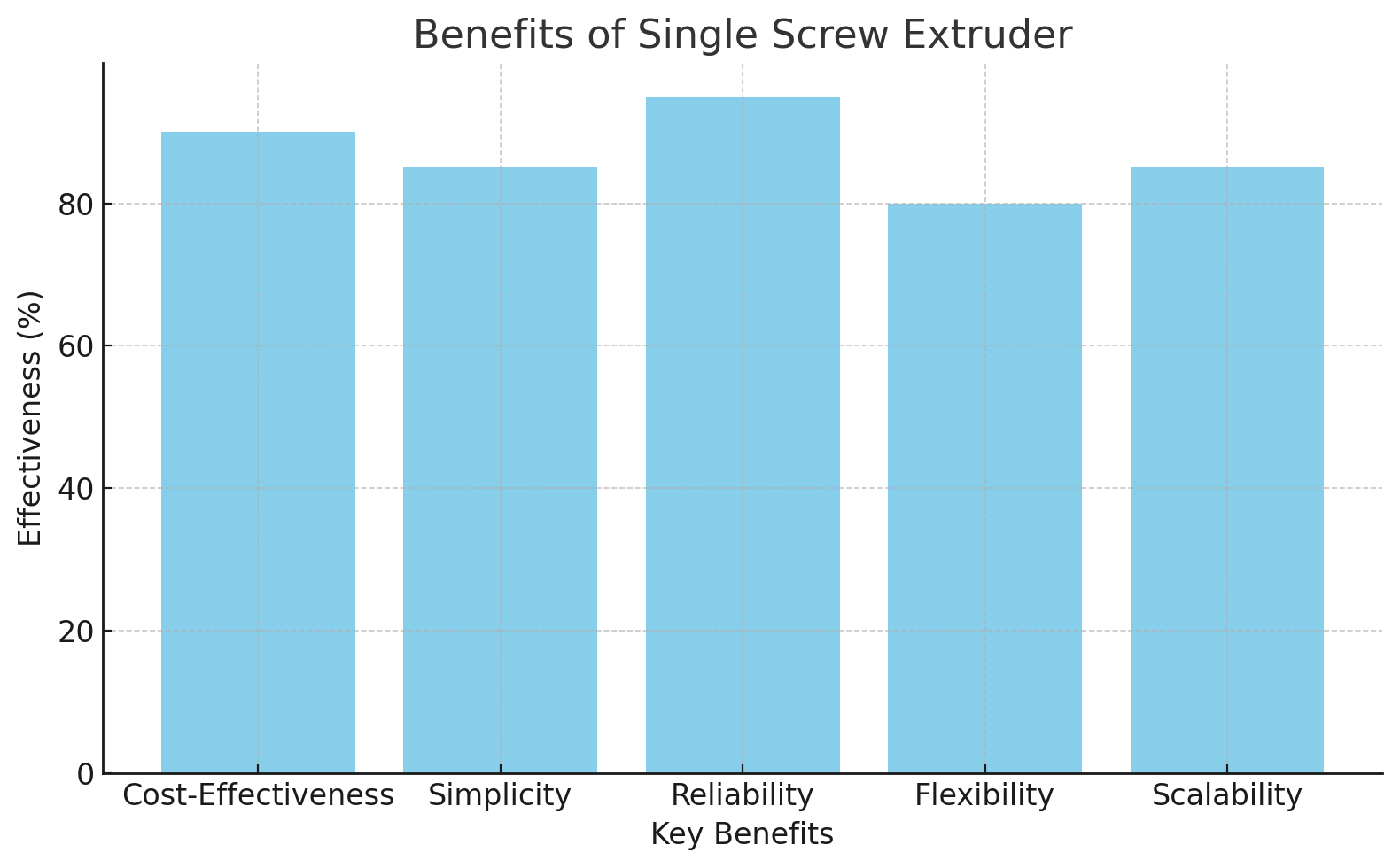
Single screw extrusion is considered a cost-effective process due to its simplicity. The machinery is less expensive to maintain and operates efficiently over long periods. This makes it ideal for large-scale production where cost control is critical.
The simplicity of the single screw design means fewer moving parts, making it reliable and less prone to breakdowns. The straightforward operation reduces the need for complex maintenance and results in consistent production output.
Single screw extruders are adaptable to a wide range of materials, from standard thermoplastics to more specialized compounds. They are also scalable, meaning businesses can start with smaller operations and expand to larger, more complex systems as demand grows.
Single screw extruders are less effective at mixing and heat transfer compared to their twin screw counterparts. This makes them less suitable for processing materials that require complex mixing or precise temperature control during the extrusion process.
While single screw extruders are effective for many standard materials, they may not be ideal for high-performance polymers or materials that require intense shearing or precise mixing. Materials like filled compounds or high-viscosity polymers may struggle in a single screw system.
The process relies heavily on the temperature and pressure within the barrel. If these are not carefully controlled, issues like material degradation or inconsistent output can occur. Maintaining proper settings is critical to ensure quality results.
● Screw Speed: Adjusting the speed of the screw controls the rate at which material is processed.
● Barrel Temperature: Accurate temperature control is essential for melting the material without degrading it.
● Material Viscosity: Materials with higher viscosities may require adjustments in screw design or barrel configuration.
To enhance performance, innovations in screw profiles and barrel configurations can be implemented. These designs help improve mixing and material flow, ensuring smoother operation and higher-quality output.
Fine-tuning the extrusion parameters, such as screw speed and temperature, based on the material’s properties, ensures optimal performance. Customizing the process allows manufacturers to meet the specific needs of various applications.
● Mixing Efficiency: Twin screw extruders generally offer superior mixing due to their intermeshing screw designs.
● Flexibility: Single screw extruders are often simpler and more cost-effective, but twin screw extruders provide better control over material properties.
● Cost: Single screw extruders are more budget-friendly compared to twin screw extruders, making them a popular choice for simpler materials and processes.
Single screw extruders are ideal for simple materials that do not require intensive mixing or high shear forces. They are more cost-effective and simpler to operate, making them an attractive option for businesses that prioritize efficiency and budget control.
The choice between single and twin screw extruders largely depends on the material being processed. For less demanding applications, single screw extrusion is an excellent option. For more complex materials, such as those requiring intricate mixing or blending, a twin screw extruder may be the better choice.
Single screw extrusion technology continues to evolve with advancements like automated control systems and improved material handling capabilities. These innovations allow for greater precision and efficiency in the production process.
As sustainability becomes increasingly important, single screw extrusion is playing a key role in recycling, particularly in processing biodegradable plastics like PLA-HAp composites. These materials can be effectively processed using single screw extrusion, contributing to a more sustainable future.
The versatility of single screw extrusion makes it an attractive option for emerging industries. In particular, the biopolymer and medical sectors are likely to see increased usage of single screw extruders for custom products and sustainable solutions.
Single screw extrusion is essential in polymer and plastic manufacturing. Its simplicity, cost-effectiveness, and versatility make it a top choice for many industries. Understanding its limitations and optimizing its performance is key to achieving optimal results.
As industries grow and the demand for sustainable products rises, the role of PVC Window Profile Machine - Eans Machinery will expand further. This process remains crucial in shaping the future of manufacturing.
Eans Machinery offers high-quality single screw extruders that deliver exceptional performance. Their products provide value through enhanced efficiency and reliable output for various industries.
A: A single screw extruder is a machine used in plastic manufacturing. It melts and pushes material through a die to shape it, using a single rotating screw within a barrel.
A: The single screw extruder uses a rotating screw to melt, mix, and move material through a barrel, shaping it as it exits through a die.
A: Single screw extruders are cost-effective, simple to operate, and ideal for producing consistent shapes with a range of materials.
A: It offers low cost, reliability, and scalability for a variety of applications, especially for thermoplastics like PVC and PE.
A: Regularly check screw and barrel alignment, ensure proper temperature settings, and clean the system to prevent material buildup.


