

close
Choose Your Site
Global
Social Media
Views: 0 Author: Site Editor Publish Time: 2026-08-24 Origin: Site


Extruding Wood-Plastic Composite (WPC) into flat profiles is a standard industry practice. Forming deep, dimensional grooves, however, requires extraordinary precision. You must carefully control melt pressure and cooling dynamics throughout the entire line. Without this strict control, manufacturers face serious production bottlenecks. Deep grooves are highly prone to material collapse. They often suffer from uneven wall thickness and severe warping during the cooling phase. These structural defects directly impact the end-user. Installers simply cannot achieve a seamless installation if the panels are warped or dimensionally inaccurate. Our goal in this article is to unpack the complex mechanical process behind deep-groove formation. We will explore the physics of material flow, die design, and aggressive calibration. We also provide a strict technical evaluation framework. This guide helps buyers confidently analyze equipment when shortlisting a wpc fluted panel machine for their manufacturing facility. You will learn exactly what separates premium extrusion from high-reject operations.
Deep grooves are formed through a combination of customized extrusion dies and high-pressure vacuum calibration, not secondary milling.
The primary cause of defect rates in deep-groove profiles is insufficient cooling or mismatched extrusion speed.
Evaluating a production line requires looking beyond maximum output speed to assess vacuum table length, die metallurgy, and haul-off stability.
Creating deep architectural ridges in composite materials relies on advanced fluid mechanics and thermal control. The physical behavior of the polymer melt dictates the success of the final product. You cannot treat fluted panels like standard flat boards.
Many traditional woodworkers assume flutes are carved out of solid blocks. This is how CNC machining works. A router bit cuts into solid material, removes mass, and creates waste. Extrusion operates on a completely different physical principle. Continuous extrusion forces molten WPC through a precisely engineered die. It forms the entire louvered profile in one single pass. You generate zero carving waste. The material compresses into the exact shape of the mold before cooling. This continuous pressure creates a denser, more durable surface layer compared to milled wood.
Comparison: Continuous Extrusion vs. CNC Milling
Process Metric | WPC Extrusion | CNC Milling |
|---|---|---|
Material Waste | Nearly 0% (Scrap is recycled) | High (Removed material is discarded) |
Production Speed | Continuous (1.5 - 3 meters/min) | Batch processing (Slow per unit) |
Surface Hardness | High (Compacted under pressure) | Medium (Exposes internal core) |
Groove Depth Limits | Dictated by die and cooling design | Dictated by material thickness |
Managing the flow of the PVC and wood fiber mix is highly complex. The extruder must push this highly viscous melt so it fills the deep "ribs" of the mold evenly. If the melt flows too fast through the center, it starves the outer edges. This causes internal stress. It can also lead to surface tearing on the deepest grooves. Engineers balance this by designing intricate flow channels inside the die. They manipulate shear rates so the material travels at a uniform velocity across the entire cross-section.
Your raw material recipe heavily dictates groove integrity. The ratio of wood powder to PVC resin determines the necessary extrusion pressure. It also dictates the ideal die temperature. Consider these formulation variables:
Wood Powder Content: Higher wood content increases stiffness but reduces melt fluidity. It requires higher torque to push into deep cavities.
Calcium Carbonate: Used as a filler, it increases dimensional stability. Too much makes the melt brittle and prone to edge cracking.
Lubricants: Internal lubricants reduce friction between polymer chains. External lubricants prevent the melt from sticking to the die walls. Both are vital for preventing surface tears on deep flutes.
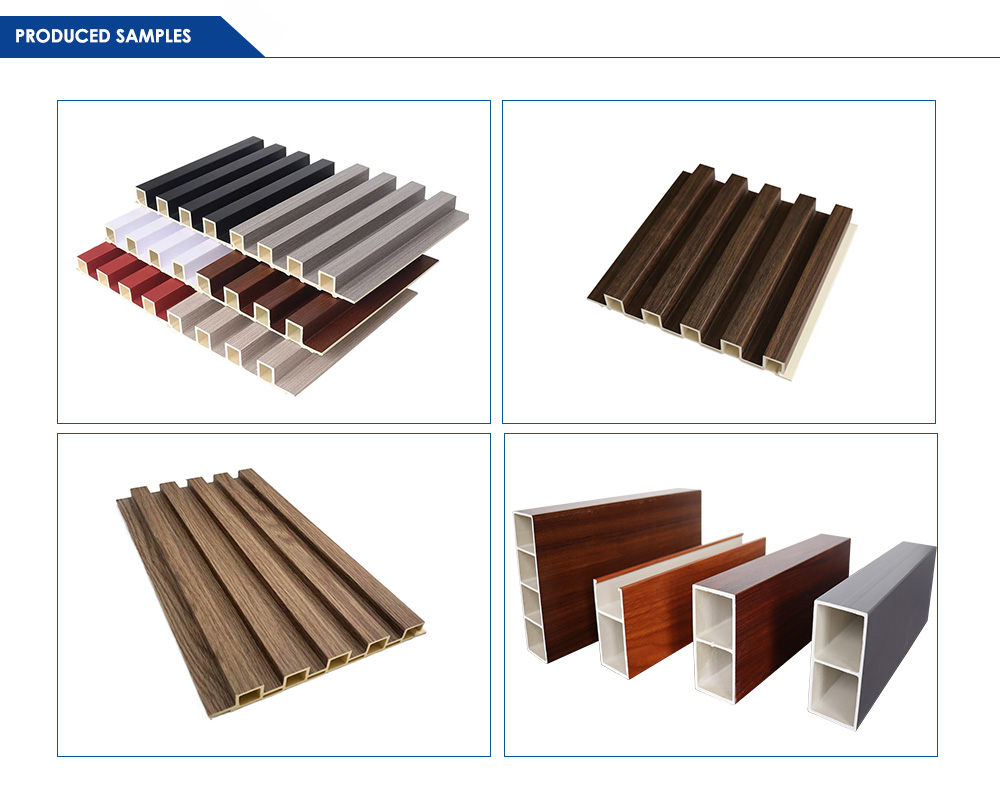
Operating a successful wpc louver panel production line requires specialized hardware. Standard PVC pipe extruders simply cannot handle the physical demands of deep-groove WPC profiles. Each component must be engineered for high torque and aggressive cooling.
You cannot use a single-screw extruder for high-quality WPC fluted panels. Conical twin-screw systems are strictly mandatory. Wood fibers are incredibly difficult to mix evenly with PVC resins. The interlocking twin screws provide superior compounding and shearing action. They also generate significantly higher melt pressure at the die head. You need this immense pressure to force the dense, dough-like material deep into intricate die cavities. Without a conical twin-screw setup, the material simply will not fill the deepest grooves.
The extrusion die is the heart of the forming process. It requires brilliant engineering. Because fluted panels have varying thicknesses, they cool and flow at different rates. To counter this, dies utilize multi-zone heating. Operators can adjust temperatures in specific sections of the mold. This ensures the deep sections of the panel flow at the exact same rate as the thin, flat backing. If the temperatures are unbalanced, the panel will exit the die curved or deformed.
This is arguably the most critical component for deep grooves. When the panel leaves the die, it is still semi-molten and malleable. It enters the vacuum calibration table. Here, strong vacuum pressure pulls the hot plastic against a precision metal shaping sleeve. Simultaneously, the system shocks the material with chilled water. This instantly freezes the outer skin of the panel. The vacuum forces the deep grooves to hold their exact shape while the core cools down. Without aggressive vacuum calibration, the deep ribs would simply collapse under their own weight.
The haul-off machine pulls the continuous panel through the cooling tanks. Standard flat caterpillar tracks will crush deep flutes. Therefore, haul-off units require custom rubber pads. These pads are molded to match the specific groove profile. They grip the fluted surface firmly but gently. They provide steady pulling force without crushing or deforming the newly formed ribs. Finally, a dust-free cutting saw slices the continuous board into retail-ready lengths.
Manufacturing deep grooves introduces severe thermal challenges. Plastic shrinks as it cools. If one side shrinks faster than the other, the entire board bows. Controlling this requires operational discipline.
You face a massive challenge when cooling thick grooved sections alongside thin backing sections. The thin back cools rapidly. The thick ribs retain heat much longer. This imbalance causes the panel to bow toward the cooler side. Operators must address this by applying symmetrical cooling. They direct higher volumes of chilled water specifically into the deep grooves. They sometimes reduce water flow on the thin flat back. This forces both sides to reach room temperature at the same time.
Sink marks are shallow depressions on the flat surface of a molded part. They occur opposite the deep grooves. As the thick rib cools and shrinks internally, it pulls the flat face inward. This creates an ugly dimple. You prevent this through precise technical adjustments. Operators increase vacuum pressure on the flat face during calibration. This vacuum holds the flat surface rigidly against the sizing sleeve until the internal rib fully solidifies.
Common Mistakes in Cooling:
Running extrusion speeds faster than the chilling tank can process.
Failing to clean calcium scale out of calibration water jets, leading to uneven spray.
Ignoring ambient room temperature fluctuations between day and night shifts.
Installers demand perfect interlocking edges. Strict dimensional tolerances during calibration are completely non-negotiable. If a panel is even one millimeter too wide, it will not snap into the adjacent panel. Uneven cooling causes micro-warps along the edges. Operators must constantly measure the tongue and groove joints with calipers during production. Consistent vacuum pressure and steady haul-off speeds guarantee these interlocking mechanisms function flawlessly on the job site.
When you prepare to buy equipment, raw specifications can be misleading. A cheap machine might claim high speeds, but it will produce high reject rates. You must evaluate the hardware using strict engineering parameters. Choosing a reliable wpc wall panel making machine requires analyzing four distinct categories.
Buyers must verify the length of the vacuum cooling tank relative to the stated output speed. Some manufacturers boast extrusion speeds of 4 meters per minute. However, if they only provide a 4-meter cooling tank, the deep grooves will not solidify. The panel will warp the moment it hits the cutting saw. Insufficient cooling at high speeds ruins deep grooves. For thick WPC flutes, you generally need extended calibration tables. Sometimes dual vacuum tanks are necessary to ensure the core is completely frozen.
Wood fibers are naturally abrasive. Calcium carbonate powder acts like liquid sandpaper inside the extruder. You must carefully assess the steel grade used in the molds. Standard steel will wear out quickly, causing the grooves to lose their sharp edges. Premium dies utilize hardened tool steel, such as 3Cr17. This steel undergoes specialized heat treatment. It provides excellent wear resistance and maintains strict dimensional tolerances over thousands of production hours.
Manual temperature control is no longer acceptable in modern extrusion. The value of advanced PLC systems is immense. Brands like Siemens provide highly responsive automation. The PLC continuously monitors melt pressure at the die head. It automates minute temperature adjustments across the barrel zones. If the pressure spikes, the system automatically slows the feeder. This intelligent control dramatically reduces scrap rates during the difficult startup phase.
Market trends change rapidly. You will likely need to produce different louver widths and depths. Evaluate how quickly molds can be swapped. Heavy dies require sturdy crane access. Look for calibration tables on automated rails that move back quickly. A well-designed machine allows a skilled crew to switch between different groove profiles safely and efficiently.
Equipment Evaluation Checklist
Component | Minimum Standard | Premium Feature |
|---|---|---|
Extruder Type | Standard Conical Twin-Screw | Customized screw geometry for high wood content |
Cooling Tank | 4-6 meters standard vacuum | 8+ meters extended dual-zone vacuum cooling |
Mold Material | Standard carbon steel | 3Cr17 forged tool steel with chrome plating |
Control System | Basic push-button relays | Siemens PLC with automated pressure feedback |
Investing in extrusion technology is a major capital decision. You must look past the initial brochure specifications. Successful buyers build a robust business case by focusing on hardware reliability and vendor accountability.
Never purchase an extrusion line blindly. The most critical step in risk mitigation is requiring a Factory Acceptance Test (FAT). You must stipulate that the manufacturer runs the machine using your specific raw material formulation before you finalize the purchase. Different wood powders behave differently. A machine that runs perfectly on local pine flour might struggle with dense oak powder. Testing your exact recipe ensures the screw geometry and die design are truly compatible with your materials.
Not all machine suppliers manufacture their own molds. Prioritize manufacturers who design, machine, and test their own dies in-house. When the machine builder also builds the mold, the two components are perfectly synchronized. If a supplier outsources their dies, troubleshooting becomes a nightmare. If a profile warps, the machine builder will blame the mold maker. The mold maker will blame the machine builder. In-house manufacturing guarantees single-source accountability.
Forming deep grooves in WPC is a sophisticated manufacturing challenge. It requires a harmonious balance of extrusion pressure, precise die engineering, and aggressive vacuum calibration. You cannot simply force hot plastic through a mold and expect sharp, architectural lines.
Our final verdict is clear. A reliable WPC extrusion line minimizes reject rates by prioritizing cooling stability over raw speed. Rushing the cooling process guarantees warped boards and frustrated installers. Fast production means nothing if the panels cannot interlock seamlessly.
As a next step, we advise all prospective buyers to request physical sample profiles from potential vendors. Ask for continuous run data showing stability over a 24-hour period. Demand a live demonstration using your materials. Rigorous vendor vetting is the only way to ensure profitable, defect-free production.
A: Generally no. WPC requires specialized screw designs for higher torque and wear resistance, plus extended cooling tables to handle the higher heat retention of wood fibers.
A: Depending on the machine's design and crane accessibility, a full die and calibrator changeover typically takes 2 to 4 hours.
A: While machines can run faster, high-quality deep grooves (e.g., 20mm+ depth) are typically extruded at stable speeds of 1.5 to 3 meters per minute to guarantee dimensional accuracy and prevent warping.


