

close
Choose Your Site
Global
Social Media
Views: 0 Author: Site Editor Publish Time: 2026-08-17 Origin: Site


Establishing a wood-plastic composite (WPC) manufacturing facility presents high stakes for any business. Capital investments run deep, and the market demands flawless end products. Achieving consistent product density and dimensional stability remains your primary challenge in scaling production. Minor thermal fluctuations during processing can quickly ruin entire batches of material.
This guide serves as your evidence-based roadmap for configuring a highly efficient production line. We will explore exactly how to optimize your extrusion parameters for maximum yield. You will learn to mitigate operational risks right from the start. We will also help you evaluate capital equipment based on performance data and mechanical reliability.
By following these specific setup protocols, you can ensure continuous operation. We detail the mixing, calibration, and tooling steps required for success. Let us dive into the technical fundamentals that transform raw wood fibers and polymers into premium door boards.
Formulation dictates baseline stability: Proper moisture control in wood powder (<2%) and exact PVC/wood ratios are non-negotiable precursors to successful extrusion.
Extruder selection is critical: The core WPC door making machine must feature precise temperature control and tailored screw geometry to prevent material degradation.
Cooling and calibration define quality: Downstream vacuum calibration directly impacts the final board's flatness and structural integrity.
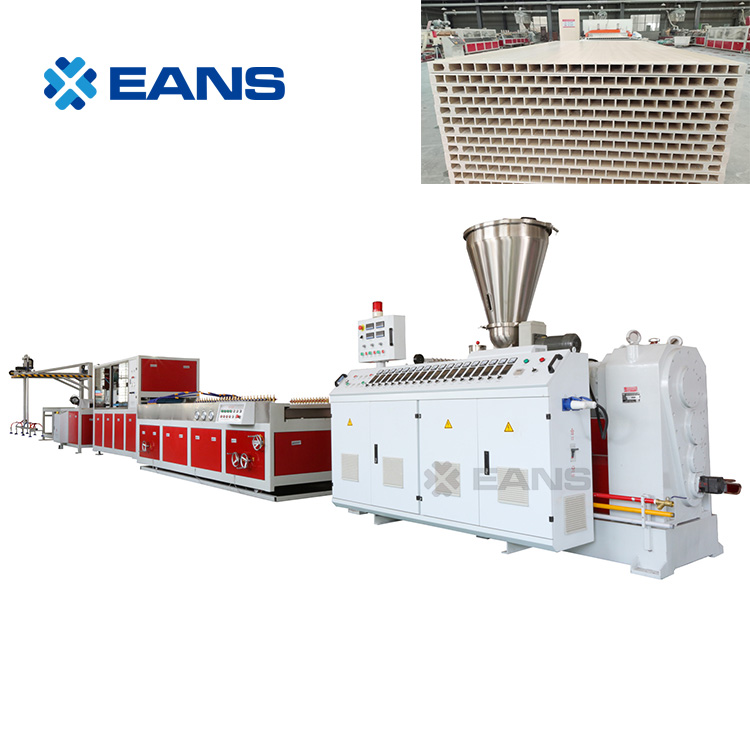
Manufacturers often underestimate the precise controls required to produce thick composite boards. The financial impact of unstable extrusion accumulates rapidly. High scrap rates erode your profit margins before finished goods ever reach the warehouse. Uneven board thickness means doors will fail to fit standard frames. Localized density variations severely compromise screw-holding strength, causing hinges to tear out during installation.
We define a successful setup through continuous operation metrics. Stable melt pressure stands as the ultimate indicator of a healthy extrusion process. Uniform plasticization ensures the board maintains structural integrity from edge to edge. You must also achieve minimal energy waste per kilogram of output to remain competitive.
Transitioning from pure PVC profiles to WPC introduces complex material nuances. Pure PVC forgives minor temperature swings. However, wood fibers act as both thermal insulators and friction-inducing abrasives. You need completely different thermal management strategies to prevent the wood flour from burning while ensuring the PVC melts completely.
Common Mistake: Operators often apply standard PVC temperature profiles to WPC materials. This creates excessive shear heat, immediately scorching the wood fibers and causing catastrophic material blockages.
Preparation dictates the success of your entire extrusion run. You must utilize high-speed hot mixing followed immediately by cold mixing. Hot mixing (typically reaching 120°C) drives off trapped moisture and blends the chemical additives. Cold mixing (dropping the batch to 40°C) prevents the foaming agents from triggering early gelation.
Load PVC resin, stabilizers, and lubricants into the hot mixer.
Introduce wood powder only after initial polymer blending begins.
Extract moisture aggressively through mixer venting until levels drop below 2%.
Discharge the compound into the cold mixer to stabilize the blend.
Allow the material to rest in a silo for 12 to 24 hours to ensure uniform dispersion.
Bringing your WPC Door Making Machine online requires patience. You must heat the twin-screw extruder sequentially. Start from the die head and work backward toward the feeding hopper. Once all zones reach their target temperatures, wait an additional 30 minutes. This allows the massive steel barrel to absorb heat evenly, avoiding thermal shock to the system.
Melt pressure regulation separates average operators from experts. Adjust your volumetric feeder speeds in strict tandem with your screw RPM. You must maintain a continuous, starve-fed material flow. Starve-feeding prevents torque overloads and keeps the melt pressure perfectly stable. If you overfeed the hopper, shear friction spikes, and the wood fibers will burn.
The wide-board die head shapes the molten plastic into its final geometric form. You must set zonal temperatures carefully across the die. The goal is to ensure uniform flow velocity across the entire 800mm or 900mm width of the door board. The edges naturally flow slower than the center due to friction.
Adjust the die lip mechanically during the initial output phase. If you notice edge-tearing, increase the temperature slightly at the die extremities. If center-swelling occurs, tighten the middle choker bars to restrict flow. You must make these adjustments in microscopic increments to avoid disrupting the delicate foaming process.
Once the board exits the die, it remains soft and highly malleable. You must configure the vacuum sizing table to lock in the board's dimensions before the core heat dissipates. Vacuum slots pull the expanding board against chilled aluminum calibration plates, forcing it to hold a perfectly flat shape.
Balancing water cooling temperatures is vital. Shocking the board with freezing water causes the outer skin to shrink too fast. This traps internal thermal stress inside the thick core. Over the next 48 hours, that internal stress will release, leading to severe post-extrusion warping. Use a graduated cooling strategy, moving from warm water in the first tank to cooler water downstream.
Choosing the correct machinery dictates your ceiling for product quality. Conical twin-screw extruders excel in high-pressure WPC output. Their tapering design naturally compresses the material, which builds excellent melt pressure for pushing wide boards. Parallel twin-screw systems offer superior mixing but often struggle to generate the sheer pressure required for heavy door boards.
Wood fibers are highly abrasive. Emphasize the need for specialized bimetallic hard-facing on your screws and barrels. Standard nitrided steel will wear down in a matter of months when processing high-wood-content formulas.
Best Practice: Always specify drive and control systems featuring PLC-based automation from reliable brands like Siemens or B&R. You need real-time monitoring of melt temperature and motor load to prevent sudden mechanical failures.
Evaluate your vacuum calibration capacity carefully. Assess the length and cooling capacity of the calibration table relative to your desired line speed. Standard doors require boards between 30mm and 45mm thick. Pulling heat out of a 45mm core requires at least 8 to 10 meters of active vacuum cooling length.
Consider long-term versatility during procurement. Determine if the system can adapt to function as a wpc foam board making machine in the future. With minor die adjustments and chemical formulation tweaks, a well-designed line can easily produce lighter foam boards, expanding your product portfolio without buying an entirely new production line.
Manufacturing thick composite boards introduces distinct processing risks. Polymer degradation remains your highest threat. PVC-based WPC has an incredibly narrow processing window. If temperatures exceed 195°C, excessive shear heat causes burning. A single burned patch can ruin continuous production runs by dragging hardened carbon particles through the die head.
Foaming instability poses another major hurdle. Maintaining a uniform micro-cellular core inside a thick board requires perfect synchronization. You must balance the activation temperature of your foaming agents with the internal die pressure. If pressure drops, the gas escapes, leaving giant voids inside the board. If pressure is too high, the board will not foam at all, resulting in a massively overweight product.
The operator competency gap often derails new factories. Highlight the absolute necessity of vendor-provided on-site training for your line operators. They must focus on troubleshooting flow irregularities intuitively. Operators need the skill to adjust die bolts and cooling valves without shutting down the line.
Table: Common WPC Extrusion Defects and Corrective Actions
Defect Symptom | Probable Cause | Corrective Action |
|---|---|---|
Edge Tearing | Die lip edges are too cold or flow is restricted. | Increase edge zone temperatures by 2-3°C; open edge lip slightly. |
Internal Voids | Foaming agent unbalanced or die pressure too low. | Increase screw RPM slightly to build pressure; adjust formulation. |
Surface Scorch Marks | Excessive shear friction or barrel temperature too high. | Lower zone temperatures; check for worn screw clearances. |
Post-Extrusion Warping | Uneven cooling or internal thermal stress. | Balance upper and lower water flow rates in the vacuum tank. |
When selecting your machinery partner, you must look closely at validation and safety. Move beyond the initial sales pitch. Demand a Factory Acceptance Test (FAT) using your specific raw material formulation. Never finalize the equipment handover until the vendor proves the machine can hit your target output using your exact wood flour and PVC ratio.
Compliance and safety protect your workforce and your facility. Ensure the extrusion line meets relevant industrial safety standards, such as CE or UL certifications. Furthermore, insist on adequate dust extraction systems. Wood powder handling generates fine particulate dust, which poses a severe respiratory hazard and a critical explosion risk if allowed to accumulate near hot extruder barrels.
Your actionable next step involves drafting a highly detailed Request for Proposal (RFP). You must specify your required capacity in kilograms per hour. Outline your exact board dimensions, including maximum width and thickness. List all required downstream auxiliaries, such as cutting saws, stackers, and laminating units.
As you build this RFP, consider how a complete wpc door board extrusion line integrates into your factory floor plan. Account for raw material staging, mixer platforms, and finished goods storage to ensure a logical, streamlined workflow.
A stable WPC setup relies equally on scientific material formulation and robust, precision-engineered machinery. You cannot compensate for poor mixing with a great extruder, nor can perfect raw materials overcome weak screw geometry. Mastering melt pressure, die tuning, and vacuum calibration guarantees a high-yield production floor.
We encourage buyers to prioritize technical support and machinery adaptability when committing to capital expenditure. Vendors who offer strong localized training will save you countless hours of downtime. Focus on acquiring systems built for the rigorous, abrasive demands of wood-plastic composites.
Consult with a technical sales engineer today. Audit your specific production capacity requirements and secure a custom line configuration tailored perfectly to your market demands.
A: Ideal production capacity typically ranges from 300 to 500 kg/hr. This output depends heavily on the chosen extruder model, screw diameter, and your specific board dimensions. High-capacity conical twin-screw machines handle these demanding throughputs most effectively.
A: WPC machines feature customized screw geometry designed for high torque and low shear to prevent burning wood fibers. They also incorporate advanced venting systems for moisture extraction, bimetallic barrel coatings for wear resistance, and much heavier-duty gearboxes.
A: Yes, these extrusion lines offer excellent modularity. You can transition to foam board production by changing the die head, reconfiguring the vacuum calibration setup, and adjusting your chemical formulation to include specific foaming agents.
A: A complete line usually requires a minimum length of 25 to 30 meters. You must also allocate sufficient factory floor dimensions for raw material mixing platforms, water cooling towers, and ample staging areas for finished goods.


