

close
Choose Your Site
Global
Social Media
Views: 0 Author: Site Editor Publish Time: 2026-11-13 Origin: Site


Investing in industrial extrusion equipment represents a significant capital expenditure. For manufacturers and building material suppliers, understanding the mechanical realities and operational requirements is critical before finalizing procurement. The global shift toward lightweight, moisture-resistant, and cost-effective building materials has rapidly accelerated demand for PVC and WPC (Wood Plastic Composite) panels. This surging market demand makes in-house extrusion a highly viable and profitable revenue stream. Many businesses now want to bring production under their own roof. This guide carefully deconstructs the extrusion process, core components, and critical evaluation criteria. We will help you assess different machine configurations and mitigate common implementation risks. You will gain the technical knowledge necessary to choose the right equipment. Our insights will help you optimize your factory layout and ensure smooth daily operations.
A complete PVC wall panel production line operates on a continuous extrusion process, requiring precise coordination between raw material mixing, plasticization, shaping, and surface finishing.
The conical twin-screw extruder is the operational heart of the system; its design directly dictates output capacity, material compatibility, and energy efficiency.
Evaluating a machine requires looking beyond top-line output speed to assess power consumption per kilogram, maintenance accessibility, and calibration stability.
Successful implementation requires careful facility planning (often requiring 20–30 meters of linear floor space) and specialized operator training for formulation management.
We define the PVC wall panel machine as an integrated, automated extrusion line. It is specifically designed to convert raw materials into finished architectural panels. The primary inputs include PVC resin powder, calcium carbonate, and specific chemical additives. The equipment continuously processes these raw powders into rigid, functional building boards.
Many material suppliers currently rely on importing finished goods. This business model often squeezes profit margins. Supply chain delays also frustrate end customers. You can solve these logistical bottlenecks through vertically integrated manufacturing. By bringing production in-house, companies take absolute control over product quality. They also drastically reduce delivery lead times and secure better wholesale margins.
The true value of this production equipment lies in its versatility. Manufacturers can produce several distinct product types on the same line. You simply swap out the extrusion dies and sizing molds. Common output profiles include:
Hollow-core decorative panels
Solid WPC (Wood Plastic Composite) structural panels
Lightweight interlocking ceiling panels
Exterior weather-resistant decorative siding
You do not need to buy entirely new lines to diversify your product offerings. This modular flexibility allows businesses to adapt to shifting market trends quickly and efficiently.
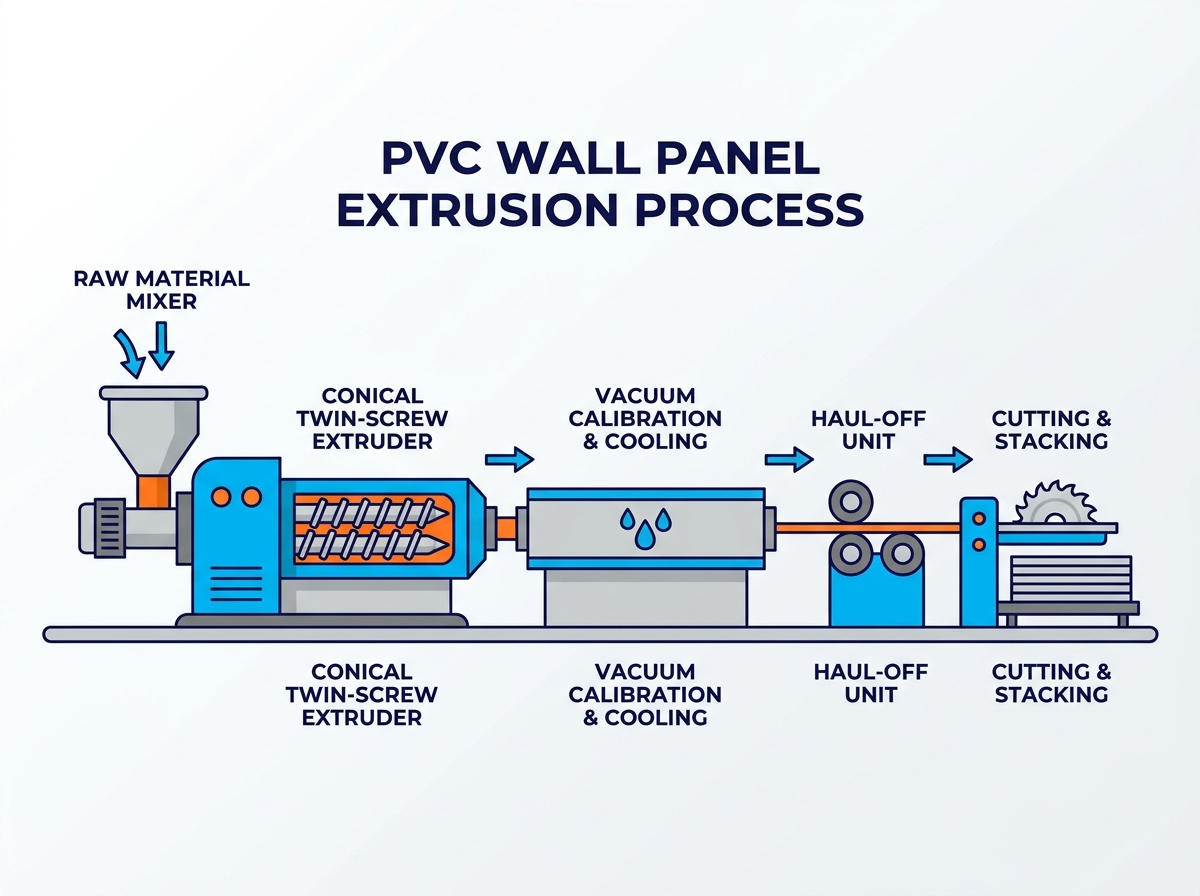
The conical twin-screw extruder serves as the operational heart of the system. Engineers consider conical twin screws the industry standard for processing PVC powder. They provide vastly superior shearing, mixing, and plasticization compared to single-screw variants. PVC powder is highly sensitive to heat and burns easily. Therefore, operators must rely on precise screw core temperature control. Specialized barrel heating zones maintain optimal melt conditions throughout the barrel length.
The molten plastic exits the extruder die and enters the vacuum calibration table. The sizing mold locks in the panel's exact dimensions. Powerful vacuum pumps hold the profile firmly against the chilled mold walls. This crucial process prevents thermal warping as the plastic solidifies. Closed-loop water cooling systems are absolutely mandatory here. They rapidly drop the temperature of the extruded profile to ensure structural rigidity.
The haul-off unit pulls the continuous profile down the production line. Caterpillar tracks or heavy-duty rubber blocks grip the panel securely. They pull the board at a perfectly synchronized speed. If the tractor pulls too fast, it stretches and deforms the hot plastic. If it pulls too slowly, the material jams dangerously behind the die head.
Automated saws slice the continuous panel into precise, market-ready lengths. Manufacturers typically use pneumatic controls or advanced PLC-guided servo saws. Tracked cutting systems move seamlessly alongside the moving panel during the cut. Dust-free cutters help maintain a clean and safe factory environment. The finished panels then slide onto automated stacking racks for final packing.
Inline surface treatment adds immense commercial value to the raw panels. Hot stamping or lamination units operate continuously before the final cut. They apply decorative films directly onto the warm panel surface. You can seamlessly add realistic wood grain, marble, or metallic finishes. Integrating this step inline saves enormous secondary labor costs.
Understanding the operational sequence helps operators troubleshoot production errors. The entire manufacturing cycle operates continuously across four distinct phases.
Phase 1: Raw Material Preparation & Mixing. Workers combine PVC resin, calcium carbonate, chemical stabilizers, and lubricants. They load these into a high-speed hot and cold mixing unit. Recipe accuracy is paramount during this stage. A slight miscalculation in the additive ratio causes brittle or discolored panels.
Phase 2: Plasticization and Extrusion. An automated screw loader feeds the mixed powder directly into the extruder hopper. High internal heat and mechanical pressure melt the dry compound. The spinning twin screws then push the molten plastic forward through the heavy steel extrusion die.
Phase 3: Shaping and Cooling. The hot, semi-liquid plastic enters the calibration mold. Intense vacuum forces hold the material in its precise shape. Cold industrial water floods the cooling table continuously. The plastic rapidly transitions into a rigid, hollow-core board.
Phase 4: Finishing and Packaging. The haul-off unit maintains continuous tension on the board. Inline laminators press the decorative surface film onto the top face. The automated saw performs precision cutting to length. Finally, workers conduct visual inspections and package the boards onto shipping pallets.
Evaluating a machine requires looking far beyond top-line output speed. You must rigorously evaluate the machine's energy efficiency. Engineers measure this metric in kilowatts per kilogram (kW/kg) of material output. Some machines boast high theoretical speeds but utilize highly inefficient motor combinations. You need to calculate the operational return on investment based on actual daily power draw.
Extruder Energy Efficiency Comparison
Extruder Model Size | Average Output (kg/hr) | Main Motor Power (kW) | Efficiency Rating (kW/kg) |
|---|---|---|---|
SJSZ 51/105 | 120 - 150 | 22 | Highly Efficient |
SJSZ 65/132 | 250 - 300 | 37 | Optimal Standard |
SJSZ 80/156 | 350 - 450 | 55 | High Output Priority |
Electrical stability dictates your factory uptime. You must insist on globally recognized brands for all critical electrical components. Use standard components from Siemens, ABB, or Schneider for inverters, PLCs, and contactors. Local technicians can easily source these replacement parts globally. Using cheap, off-brand electrical parts often causes agonizing and expensive production downtime.
Modern PVC formulations contain heavy amounts of calcium carbonate filler. This dense mineral acts like sandpaper inside the heating barrel. You must closely assess the wear resistance of the internal components. Bimetallic alloys are strictly necessary to handle high calcium formulations. They prevent premature mechanical degradation and extend the lifespan of your core extrusion components.
Modern production lines feature advanced PLC touchscreen interfaces. They offer one-touch recipe storage, real-time temperature monitoring, and intelligent fault diagnostics. These highly automated systems reduce your daily reliance on highly specialized operators. They make the complex extrusion line much easier to run, troubleshoot, and manage across multiple worker shifts.
You need adequate factory footprint before placing an equipment order. A complete PVC wall panel machine often exceeds 25 meters in linear layout length. You must also account for heavy-duty three-phase power supply needs. Furthermore, industrial water cooling infrastructure requires its own dedicated plumbing and chilling layout. Poor spatial planning leads to cramped, unsafe working conditions.
Even the most expensive equipment produces high scrap rates without the right chemical recipe. The PVC, calcium, and additive formulation must be dialed in perfectly. Formulation mistakes cause brittle edges, poor surface adhesion, and uneven cooling. You must secure technical commissioning support from the manufacturer. They will help you optimize your initial powder recipes for local climates.
Identify high-wear components early in your procurement process. Extruder screws, barrels, electrical heating bands, and cutting blades degrade naturally over time. Establish a rigorous preventative maintenance schedule immediately. Keep critical spare parts in your factory inventory. Regular maintenance helps you avoid disastrous unplanned downtime during peak construction seasons.
Industrial mixing and automated cutting generate significant airborne dust. The high-heat extrusion process also creates chemical off-gassing. You must install proper overhead ventilation systems across the production floor. Managing these emissions protects your workers' health. It also helps your factory strictly meet local occupational safety and environmental compliance standards.
Choosing the right production equipment requires balancing output goals with your operational realities. You must carefully consider available floor space, capital budget, and internal technical expertise. A successful installation demands high-quality mechanical components alongside accurate chemical formulations. We advise buyers to request detailed technical floor layouts before making decisions. Ask manufacturers for complete component origin lists to verify electrical part brands. Always request operational energy consumption data to forecast your monthly overhead. Completing these critical next-step actions ensures a smoother procurement process and a faster path to profitability.
A: A standard production line requires a minimum linear length of 25 to 30 meters. You must also allocate additional space for raw material mixing stations, water chilling tanks, and finished goods storage. Maintain at least two meters of clearance around the machine for safe operator access.
A: Yes, one machine can produce various profiles. You simply change the steel extrusion die and the vacuum calibration mold. This interchangeability allows you to manufacture hollow panels, solid panels, and different widths without buying a completely new production line.
A: Formulations vary, but a common ratio uses 1 part PVC resin to 1.5 or 3 parts calcium carbonate. Higher calcium carbonate ratios reduce raw material costs but can make the panel heavier and slightly more brittle if not balanced with appropriate impact modifiers.
A: A highly automated line usually requires one to two main operators per shift. You will also need one dedicated worker to manage the raw material mixing station. Additional general labor is often required for packaging and moving finished pallets.


