

close
Choose Your Site
Global
Social Media
Views: 0 Author: Site Editor Publish Time: 2026-08-04 Origin: Site


Formulating Wood-Plastic Composites (WPC) for interior doors requires precise material synergy. The raw materials you choose do more than dictate the quality of the final product. They directly determine the mechanical specifications required for your extrusion equipment. Operators often face significant challenges when launching a new production line. Investing in a standard plastics extruder for high-density wood composites typically results in premature screw wear. You might also experience poor foaming and high scrap rates. Evaluating a machine requires aligning its technical capabilities with your specific material formulation. If they do not match, the entire production process becomes unstable.
This article details the exact material composition required for WPC door production. We highlight the implementation risks of poor material selection. You will also discover a clear framework for matching material specs to the right machinery. By understanding these variables, you can optimize your factory floor and ensure consistent output.
WPC doors predominantly rely on a PVC (Polyvinyl Chloride) base rather than PE or PP, due to its superior foaming capacity, rigidity, and paintability.
Wood fiber (or wood flour) must be milled to a specific mesh size (typically 80–120) and dried to below 2% moisture content before entering the extruder.
Chemical additives, particularly foaming agents and stabilizers, make up a minor percentage of the mix but dictate up to 80% of the processing stability.
The chosen material ratio mandates specific machine configurations, specifically requiring conical twin-screw extruders designed for high-torque, low-shear processing.
While WPC decking often uses Polyethylene (PE) or Polypropylene (PP), interior doors demand a different approach. Outdoor decking prioritizes weather resistance and impact strength. Interior doors require strict structural and aesthetic characteristics. You cannot swap these polymers without compromising the final product.
Polyvinyl Chloride (PVC) stands as the undisputed champion for interior composite doors. It delivers two critical advantages over its PE and PP counterparts: superior foaming capacity and enhanced fire resistance.
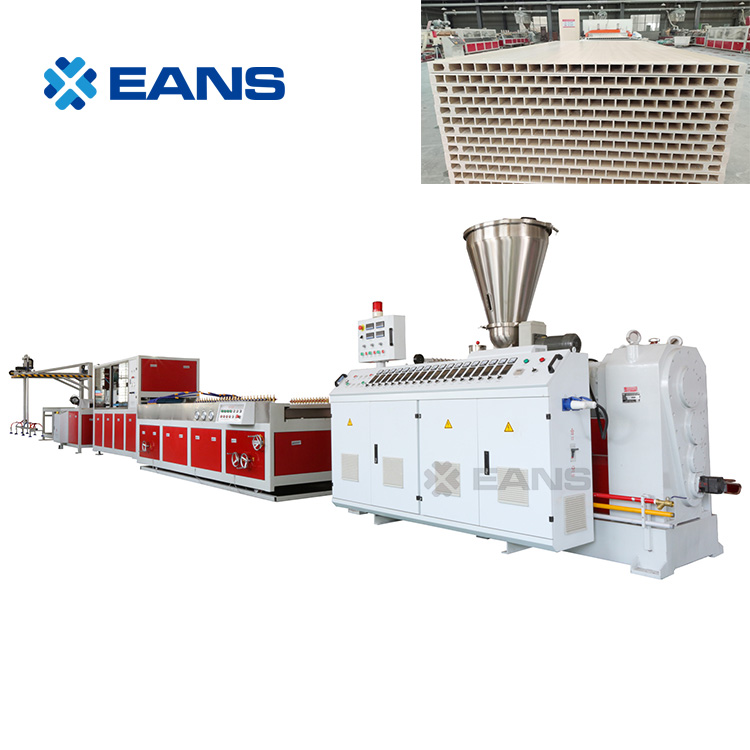
A reliable wpc foam board making machine relies heavily on PVC. The polymer traps gas efficiently during the extrusion process. This creates a dense, micro-cellular foam core. You effectively reduce product weight and lower material costs. Best of all, you achieve this without sacrificing dimensional stability.
Furthermore, PVC naturally offers higher stiffness. It contains chlorine, which imparts excellent flame-retardant properties. Building codes for interior doors demand strict fire compliance. PVC easily meets these standards, making it the safest choice for residential and commercial interiors.
Operators frequently debate using virgin versus recycled PVC resins. Your choice directly influences processing stability and equipment wear.
Virgin PVC offers maximum stability. It delivers predictable foaming behavior and consistent melt viscosity. When you use virgin resin, you encounter fewer unexpected process variations.
High-quality recycled PVC (post-industrial) offers another path. It can lower initial capital expenses for materials. However, incorporating recycled resin introduces specific manufacturing challenges. You must implement advanced melt filtration systems. Recycled materials often contain hidden contaminants. Highly consistent sorting becomes mandatory. Without these precautions, you risk frequent extruder jams and compromised door profiles.
Polymer Type | Primary Application | Foaming Capability | Fire Resistance | Rigidity |
|---|---|---|---|---|
PVC (Polyvinyl Chloride) | Interior Doors, Frames | Excellent | High (Self-extinguishing) | Very High |
PE (Polyethylene) | Outdoor Decking | Poor | Low | Moderate |
PP (Polypropylene) | Automotive, Fencing | Moderate | Low | High |
The "wood" component in WPC introduces biological variables into an otherwise predictable chemical process. Managing these natural variables is the highest hurdle in facility operations. Wood behaves inconsistently. You must control its physical state before it ever touches the extruder.
Producers typically use wood flour or fine wood fibers. Particle size and moisture levels act as the most critical control points.
Optimal fiber size ranges strictly from 80 to 120 mesh. If you use coarser fibers, they cause surface defects. Large particles poke through the polymer matrix. This creates rough textures and complicates the painting process. Conversely, finer fibers cause different problems. They increase bulk density and absorb too much resin. This drives up your material costs significantly while slowing down production speeds.
Moisture content requires even stricter management. Wood flour must be dried to below 2% moisture before compounding. Excess moisture causes steam pockets during high-temperature extrusion. These pockets lead to surface bubbling and structural voids inside the door. You will face unacceptable scrap rates if you ignore moisture control.
Operators rarely use wood and plastic alone. Calcium Carbonate (CaCO3) plays a vital supporting role in the formulation.
Used alongside wood flour, CaCO3 increases the dimensional stability of the final door. It prevents warping under temperature changes. It also reduces overall raw material costs, as it is significantly cheaper than both PVC and prepared wood flour.
However, you face severe risks if you misuse it. Overloading the mix with CaCO3 pushes beyond recommended formulation ratios. Calcium Carbonate is basically crushed stone. Excessive amounts cause severe abrasive wear on your extruder screws and barrels. You will severely shorten your machine lifespan. Replacing bi-metallic screws is an expense you want to delay as long as possible.
A standard wpc door making machine cannot process raw plastic and wood alone. The mixture requires a precise cocktail of additives. These chemicals manage extreme heat and friction. While they make up a tiny percentage of the total weight, they dictate process stability.
You must carefully balance four main categories of additives. Missing even one will cause catastrophic extrusion failures.
Foaming Agents (NC/AC): These are essential for density reduction. They create the cellular structure inside the door profile. Using them requires precise temperature control in the barrel zones. The goal is to trigger chemical expansion exactly as the melt exits the die. If they trigger too early, the gas escapes through the vacuum vent.
Heat Stabilizers: PVC degrades rapidly under heat. It releases hydrochloric acid when burned. Heat stabilizers prevent the compound from burning during the high-friction extrusion process. Common choices include Calcium-Zinc or Lead-based formulas.
Lubricants (Internal and External): Wood composites act like thick paste. Internal lubricants reduce friction between polymer chains. They improve overall melt flow. External lubricants prevent the sticky WPC compound from adhering to the metal surfaces. They keep the material moving smoothly through the extruder and calibration molds.
Coupling Agents (Silane/Maleic Anhydride): Wood fibers are hydrophilic (they absorb water). Plastic molecules are hydrophobic (they repel water). Coupling agents bridge this chemical gap. They bind the wood to the plastic, ensuring long-term structural integrity.
You cannot finalize your equipment purchase without locking in your material strategy. The exact formulation dictates the architecture of the wpc door board extrusion line. Buying a machine off the shelf without checking material compatibility guarantees failure.
High wood-fiber ratios demand a specific mechanical approach. They require high pressure and low shear. Conical twin-screw extruders are absolutely mandatory for this application.
Single-screw extruders generate too much frictional heat. They will burn the wood flour instantly. Parallel twin-screws lack the necessary compression for dense WPC. Conical twin-screw extruders provide the necessary compaction. They push the material forward efficiently without generating excessive shear heat. This preserves the delicate wood fibers and sensitive foaming agents.
Wood holds residual moisture, even after thorough drying. It also contains naturally occurring volatile organic compounds (VOCs). As the mixture heats up inside the barrel, these gases expand.
Your machine must feature a high-efficiency vacuum degassing zone on the barrel. This vacuum system extracts harmful gases before the material reaches the die. If the degassing system fails, the trapped gases create large blowholes in the final door. You must ensure the vacuum pump is properly sized for your specific wood percentage.
WPC foam expands immediately upon exiting the die. You must control this expansion perfectly to achieve correct door dimensions.
The formulation's specific expansion rate determines your cooling needs. It dictates the length and cooling capacity of the vacuum calibration table. The table uses water and vacuum pressure to freeze the door board into its final shape. Formulations with high foaming ratios require significantly longer cooling tanks. If your cooling tank is too short, the core remains hot. The door will warp and deform as it rests on the factory floor.
Formulations look remarkably simple on paper. However, they present massive operational risks on the factory floor. You must verify every material claim through rigorous physical testing.
Procurement teams often look for the cheapest available additives to cut costs. This strategy usually backfires. Cheap additives are rarely pure. They often require much higher dosing rates to achieve the desired effect. This negates any initial cost savings.
Furthermore, poor-quality wood flour introduces severe mechanical risks. Low-grade wood often contains high amounts of sand and silica. These highly abrasive materials act like sandpaper inside the extruder. They will destroy standard steel screws in a matter of months. If you use cheap wood, you must invest heavily in bi-metallic screws and barrels. This increases your initial machine capital expenditure.
Global markets impose strict regulations on building materials. You must align your material selection with regional compliance standards.
If you target European or North American markets, you face strict chemical bans. Your formulations must completely avoid heavy-metal stabilizers. Lead-based stabilizers are cheap and highly effective, but they are illegal in many regions. You must opt for eco-friendly Calcium-Zinc alternatives.
Switching to Calcium-Zinc introduces new operational challenges. These green stabilizers have a much narrower processing window. They degrade faster if temperatures fluctuate. Therefore, using them requires highly precise machine temperature controls. You must upgrade your extruder’s heating and cooling sensors to maintain compliance without sacrificing product quality.
Success in WPC door manufacturing is a 50/50 split between material chemistry and machine capability. You cannot compensate for poor materials with an expensive machine. Likewise, great formulations will fail inside incorrect extruders. Using a PVC base, perfectly dried wood flour, and precise foaming additives are the non-negotiable inputs for interior doors.
Before committing to a machine supplier, you must demand a material trial. Send your intended formulation to the manufacturer. Alternatively, request to use their standard mix. Run a physical test on their equipment. You need to verify throughput rates, check foam density, and observe continuous processing stability. Only proceed when the machine proves it can handle your exact chemical recipe smoothly.
A: No, it is highly discouraged. PE and PP are standard for outdoor decking but do not foam as effectively as PVC. This makes the resulting doors too heavy. They are also notoriously difficult to paint, glue, or laminate. Interior doors require the specific rigidity and surface properties that only PVC provides.
A: While formulations are often proprietary, a standard baseline exists. It consists of roughly 50-60% PVC resin, 15-25% wood flour, and 10-15% Calcium Carbonate (CaCO3). The remaining 5-10% consists of foaming agents, heat stabilizers, and essential lubricants.
A: The extrusion line itself does not mix the raw materials. You must invest in an auxiliary high-speed hot/cold mixing unit (Heiz-Kühl-Mischer). This machine homogeneously blends the PVC, wood flour, and chemical additives prior to feeding them into the extruder.
A: Moisture above 2% will vaporize under the intense heat and pressure of the extruder barrel. This steam overwhelms the vacuum degassing system. It causes blowholes in the door profile and reduces structural strength. The expanding steam can also potentially damage the extrusion die through dangerous pressure spikes.


