

close
Choose Your Site
Global
Social Media
Views: 0 Author: Site Editor Publish Time: 2026-11-13 Origin: Site


Investing in industrial extrusion equipment carries massive financial stakes. Procurement decisions directly impact your production yield, energy overhead, and final product quality. A misjudged specification can lead to endless bottlenecks, while the right setup guarantees consistent output. However, buyers often get lost in manufacturer marketing fluff instead of focusing on verifiable capabilities.
This article bridges the gap between technical machine specifications and commercial production goals. We strip away the jargon to help you focus on what actually matters on the factory floor. You will learn how to evaluate core components, avoid hidden downstream bottlenecks, and align equipment with your exact business model. Keep in mind, the "best" setup depends entirely on your specific facility constraints, PVC resin to calcium carbonate formulation targets, and regional market demands. Let's dive into the evidence.
Output capacity relies on the synergy between the conical twin-screw extruder and downstream calibration, not just raw motor power.
Automation (PLC controls) significantly reduces material waste during start-up phases but requires stable power infrastructure.
Facility planning—specifically cooling water circulation and total power load—must be finalized before finalizing machine specifications.
A reliable procurement decision requires mandatory Factory Acceptance Testing (FAT) using your exact material formulation.
You must define your end product before looking at machine catalogs. Match equipment capabilities directly to your target market needs. Standard hollow PVC panels dominate the residential interior market. Heavy-duty WPC (Wood Plastic Composite) panels serve commercial spaces. Co-extruded surfaces offer premium, scratch-resistant finishes. Each product type requires different screw geometries and cooling capacities.
Volume versus flexibility presents a major strategic trade-off. High-speed, single-profile lines maximize raw output. They run continuously with minimal intervention. However, versatile lines handle frequent mold changes easily. You might need to produce various widths like 200mm, 250mm, 300mm, or 600mm. A versatile setup prevents idle time when regional market demands shift unexpectedly.
Consider the true cost of downtime. Machine reliability directly protects your profit margins. Do not view reliability as an optional premium feature. Look for standard, non-proprietary wear parts. Custom components delay repairs and halt production for weeks. When selecting a PVC wall panel machine, you must establish clear success criteria to ensure maximum uptime and minimal scrap.
Survey local competitors to determine the most popular panel widths in your region.
Calculate your break-even point based on a realistic 70% operational efficiency, not the 100% theoretical maximum.
Standardize your panel thicknesses to minimize the number of calibration molds required.
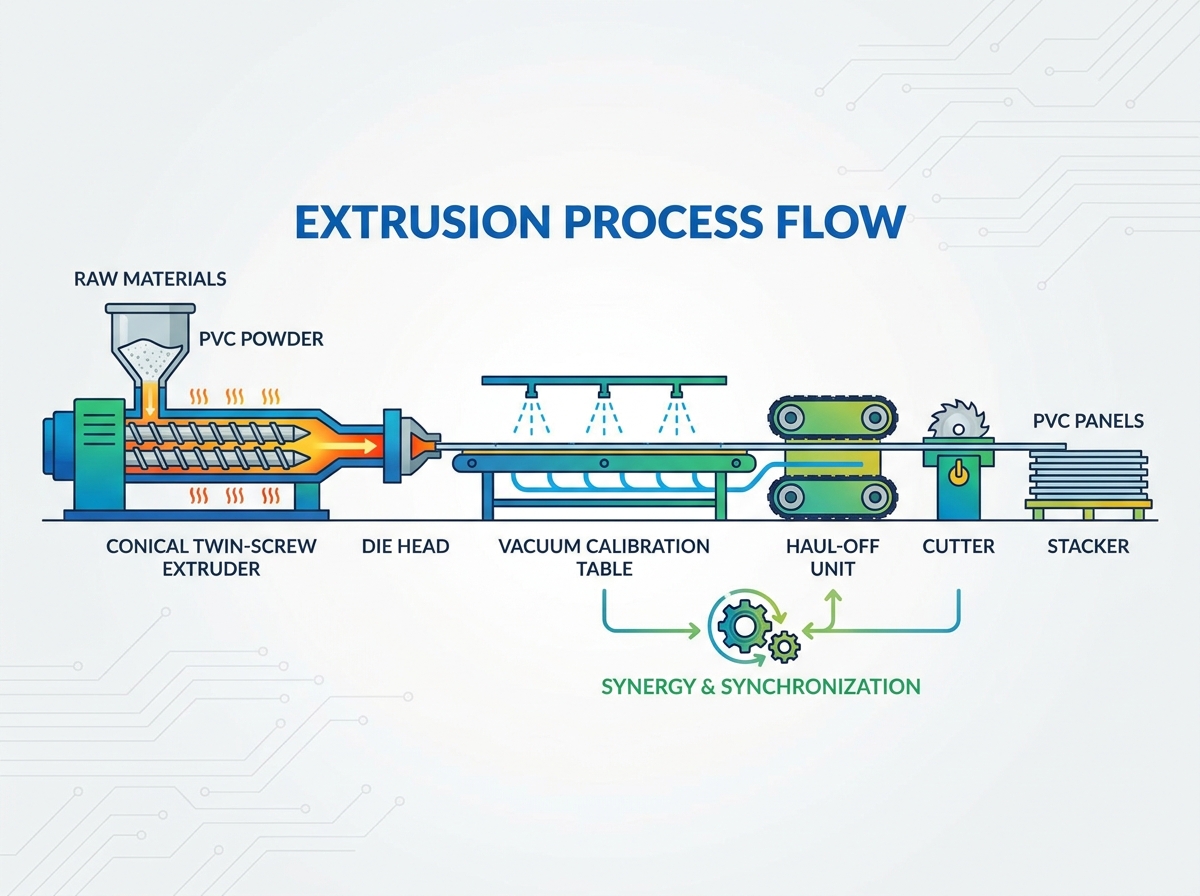
Conical twin-screw extruders represent the industry standard for dry blend processing. Models like the SJSZ 65/132 or SJSZ 80/156 handle PVC powder exceptionally well. Screw design dictates plasticization quality. This matters heavily when you use high-filler formulas. High calcium carbonate ratios require specialized screw geometries. The screws must shear and melt the material uniformly without degrading the polymer.
Motor and drive systems determine overall energy efficiency. Evaluate AC motors paired with Variable Frequency Drives (VFDs). VFDs offer precise RPM control. They reduce power spikes during startup and ensure consistent extrusion pressure. Always insist on top-tier gearbox brands. Heavy torque loads will destroy cheap gearboxes quickly, leading to catastrophic production halts.
Heating and cooling zones manage the delicate melting process. PID temperature control provides necessary accuracy. Precise heating prevents material degradation. Efficient barrel cooling proves equally critical. Both air and oil-based cooling systems work well depending on the ambient climate. They prevent the PVC from burning inside the barrel due to excessive friction.
Table: Common Extruder Configurations and Output Capabilities
Extruder Model | Screw Diameter (mm) | Typical Output (kg/h) | Best Suited For |
|---|---|---|---|
SJSZ 51/105 | 51 / 105 | 100 - 150 | Small profiles, narrow ceiling panels |
SJSZ 65/132 | 65 / 132 | 200 - 250 | Standard 200mm to 300mm wall panels |
SJSZ 80/156 | 80 / 156 | 350 - 450 | Wide 600mm panels, heavy WPC boards |
Over-speeding the screws to artificially boost output, resulting in poorly melted PVC.
Ignoring gearbox oil changes, which leads to premature bearing failure.
Using generic screw designs for highly specialized, high-calcium formulations.
Downstream bottlenecks can ruin perfect extrusion. The vacuum calibration table cools and shapes the hot profile. Specify a table length of 4 to 6 meters. This length guarantees adequate cooling time for the plastic. Shape retention depends entirely on this stage. High-quality water pumps and vacuum pumps are non-negotiable. Weak pumps cause panel warping and dimensional failures.
The haul-off unit pulls the panel forward. Caterpillar tracks utilize heavy-duty rubber blocks to grip the material firmly. The traction speed must synchronize perfectly. It must match the main extruder speed exactly. Poor synchronization causes profile stretching. It can also cause severe line jamming, wasting hours of production time.
Cutting and stacking end the manufacturing process. Traditional saw cutting creates massive dust issues inside the factory. Dust-free cutters provide cleaner edges and better facility hygiene. Automated stackers handle the finished boards gently. Automation reduces manual labor requirements at the end of the line. It also prevents human handling errors that scratch the panel surfaces.
Inspect the rubber blocks on the haul-off unit for durometer consistency. Too hard, and they crush the panel. Too soft, and they slip.
Verify the vacuum table uses stainless steel manifolds to prevent long-term rust accumulation.
Ensure the dust-free cutter uses a high-speed planetary mechanism for perfectly square cuts.
Control systems balance upfront cost against daily operational efficiency. Siemens or ABB PLC touch-screen systems require a higher initial investment. Relay control systems cost much less initially. However, PLCs offer immense long-term savings. They reduce scrap during the tricky startup phases. They also provide superior fault diagnostics when things go wrong.
Data logging changes how your operators manage production. Recipe management saves specific formulation parameters. You can store exact temperatures and screw speeds for each panel type. This drastically reduces start-up times. It also reduces your dependency on highly skilled veteran operators, making new staff onboarding much easier.
Safety and compliance fail-safes protect your industrial investment. Look for automatic shutdown protocols integrated into the software. Over-torque and over-pressure alarms prevent severe mechanical failures. Emergency stop integrations protect the physical machine. More importantly, they protect your factory operators from catastrophic injury.
Real-time melt pressure monitoring with automatic speed reduction protocols.
Historical trend graphs for heating zone temperatures to spot failing heater bands.
Multi-language support on the HMI (Human Machine Interface) for diverse operator teams.
Machine footprint dictates your factory layout. A full extrusion line spans 20 to 30 meters in length. You also need ample space for raw material mixing equipment. Finished goods storage requires significant square footage. Map these physical dimensions realistically before you order any equipment to avoid spatial constraints.
Power grid constraints often surprise new buyers. Total installed power frequently reaches 100kW to 200kW or more per line. Stable voltage remains absolutely essential. Voltage drops cause VFD faults instantly. They also lead to material burning inside the barrel if the cooling fans lose power.
Water and air infrastructure support the entire cooling process. Calculate required cooling water flow rates early. Hot climates require dedicated industrial chillers. Chillers maintain vacuum calibration efficiency when ambient summer temperatures rise. Without cold water, you cannot run the machine at full speed.
The formulation factor determines your ultimate success. Machine specs mean nothing without the correct PVC recipe. Equipment must be tuned to local raw material qualities. Calcite particle size and resin grades vary globally. You must communicate your intended recipe to the machine manufacturer early.
Upgrade the main electrical transformer to handle simultaneous startup surges from multiple motors.
Install dedicated drainage trenches beneath the vacuum calibration table to manage water spillage.
Build a temperature-controlled isolation room for the high-speed mixer to contain PVC dust.
Demand complete component transparency from equipment manufacturers. Insist on knowing exact electrical and mechanical brands. Check the origin of electrical contactors, inverters, and bearings. Brands like Schneider, Omron, and NSK signify quality. Avoid manufacturers who refuse to list the specific brands on their proforma invoices.
Mandatory Factory Acceptance Testing (FAT) protects your purchase. Never approve shipping without a successful continuous run test. Run this test at the manufacturer’s facility before final payment. Use your specific mold and exact raw material formulation. A machine running generic test powder proves nothing about real-world performance.
Evaluate warranty and spare parts availability carefully. Review the manufacturer's Service Level Agreement (SLA). Focus on replacement timelines for heavy items like screw and barrel units. Check the global availability of standard ceramic heaters and thermocouples used on their machines.
Installation and training must be formalized in writing. Ensure the contract includes on-site commissioning. The manufacturer's engineers should train your operators in your factory. Proper training prevents expensive operator errors during the crucial first month of production.
Refusal to allow third-party inspection during the FAT process.
Vague contract language regarding output guarantees (e.g., "up to 300kg/h" without specifying conditions).
Lack of comprehensive English operation manuals and wiring diagrams.
Evaluating extrusion equipment requires looking far beyond top-line output numbers. You must assess the synchronization of the entire production line, from the twin-screw extruder to the automated stacker. A single weak component will throttle your entire factory's output.
The best return on investment comes from matching technical specs to your specific facility constraints and formulation strategy. Do not overpay for automation if your power grid is unstable. Conversely, do not skimp on cooling capacity if you operate in a hot climate.
We highly encourage buyers to finalize their exact panel dimensions and daily capacity targets first. Once you know your numbers, request detailed, component-level quotes. This ensures you receive accurate, comparable proposals that lead to a profitable, long-term manufacturing operation.
A: Output capacity varies based on the extruder size and the panel's weight per meter. Typical production ranges from 150kg/h for smaller machines up to 400kg/h for heavy-duty setups. High-filler formulations generally process slower than resin-rich recipes.
A: Yes, it is entirely possible. You simply change the extrusion mold and tune the downstream calibration table. However, the new product widths must fall within the specific physical limits of the machine's vacuum table and haul-off unit.
A: You must differentiate between "installed power" on the spec sheet and "actual running power." Once operational temperatures are reached, the actual running power is typically 60% to 70% of the maximum installed power.
A: Lifespan depends heavily on the amount of calcium carbonate used in your formulation. Higher filler ratios create extreme friction, which accelerates wear. In high-filler environments, you generally need to replace or rebuild the screw and barrel every 1 to 3 years.


