

close
Choose Your Site
Global
Social Media
Views: 0 Author: Site Editor Publish Time: 2026-11-20 Origin: Site


The baseline sticker price of a PVC wall panel machine represents only a fraction of the capital expenditure required to launch or scale production. Many manufacturers face severe budget overruns early in their projects. They often fail to account for auxiliary equipment, shipping logistics, and operational downtime caused by under-specced machinery. You cannot simply look at a quote and assume it covers your entire investment.
This guide deconstructs the actual financial outlay required for these production lines. We provide a transparent framework to evaluate supplier quotes, operational expenses, and long-term profitability. You will learn how to look past exaggerated manufacturer return-on-investment claims and build a realistic, comprehensive budget. By understanding the nuances of extrusion systems and hidden setup fees, you can protect your margins. We will explore how automation, auxiliary tools, and raw material formulation directly impact your bottom line.
Base machine costs vary significantly based on automation levels and extrusion capacity (typically utilizing conical twin-screw extruders).
Auxiliary equipment (mixers, crushers, water chillers) and factory infrastructure often add 30-50% to the initial machinery budget.
Long-term profitability depends more on raw material formulation efficiency (BOM optimization) and power consumption than the initial equipment discount.
Evaluating suppliers on after-sales support, component origins (e.g., Siemens motors, ABB inverters), and compliance (CE/ISO) is critical for risk mitigation.
When you purchase a primary production line, you buy a synchronized system of individual components. Each module dictates the final quality of your product and the reliability of your operation. Understanding these components clarifies exactly where your capital expenditure goes.
The heart of any profile line is the conical twin-screw extruder. This specific design handles PVC powder exceptionally well. It forces the raw material through a heated barrel under immense pressure. There is a significant cost delta between entry-level and high-capacity models. Entry-level extruders often use basic steel alloys. Premium high-capacity machines utilize bimetallic screws and heavily reinforced gearboxes. Screw design directly impacts your calcium carbonate filling ratios. Calcium carbonate acts as an inexpensive filler. A well-designed screw allows you to increase this filler ratio safely. You reduce daily material costs without sacrificing panel rigidity. However, pushing high filler ratios through a cheap screw destroys the metal rapidly.
Once the hot plastic exits the die, it enters the vacuum calibration table. This unit uses water and intense suction to freeze the panel into its precise final shape. The length and material quality of this table heavily influence pricing. Longer tables allow for faster line speeds because they provide more cooling time. Cheap tables use thin, low-grade steel. They rust quickly due to constant water exposure. Premium calibration tables use thick 304-grade stainless steel. They maintain consistent vacuum pressure over years of continuous operation, preventing warped or rejected panels.
The haul-off unit pulls the hardened panel down the line. Standard caterpillar haul-offs work fine for basic speeds and offer an affordable entry point. However, servo-driven haul-offs provide absolute precision. They maintain exact tension. The cutting unit then slices the panel to length. Standard pneumatic cutters are cheap but often leave rough edges. Servo-driven precision cutters match the extrusion speed perfectly. They produce a flawless edge. You generate less scrap and eliminate the need for manual edge trimming.
Modern consumers demand wood, marble, or metallic finishes. You achieve these via hot stamping or lamination. Online lamination units sit directly after the cutter. You apply decorative film while the panel retains residual heat. High-quality lamination units cost more upfront but prevent blistering and peeling. The market strongly demands these budget-conscious, high-aesthetic designs. Investing in a premium surface treatment module allows you to charge higher retail prices for your finished panels.
Buyers must align their budget with their actual production requirements. Over-specifying drains your capital. Under-specifying cripples your output. Automation and capacity metrics serve as the primary drivers of your initial quote.
An entry-level line requires intensive manual labor. Operators must manually pull finished panels, stack them onto pallets, and package them into cartons. This human element bottlenecks your maximum line speed. A fully automated setup eliminates this friction. Automatic stackers handle the panels gently. Robotic packaging units wrap them efficiently. You eliminate several manual workers per shift. The upfront cost for automation is substantial, but the daily labor savings quickly offset this expense in high-wage regions.
Production Feature | Entry-Level Configuration | Fully Automated Configuration | Impact on Overall Budget |
|---|---|---|---|
Handling & Stacking | Manual operator removal | Vacuum-assisted robotic stacker | Increases CapEx; lowers daily labor costs |
Packaging Process | Manual wrapping/boxing | Inline automatic shrink wrapper | Adds 15-20% to machine price; speeds up logistics |
Output Capacity | 100 - 150 kg/hour | 250 - 400 kg/hour | Lowers the overall cost per kilogram of production |
Data Tracking | Basic analog readouts | Integrated SCADA system | Improves waste reduction and quality control |
Evaluating the raw machine price often misleads buyers. You must calculate the cost per kilogram of output. A machine priced at $30,000 producing 100 kg/hour costs $300 per unit of capacity. A robust machine priced at $50,000 producing 250 kg/hour costs $200 per unit of capacity. The more expensive machine actually offers better structural value. It generates revenue faster and utilizes factory floor space more efficiently.
Never cut corners on electrical infrastructure. Machines specifying premium programmable logic controllers (PLCs), heavy-duty contactors, and high-end variable frequency drives (VFDs) cost noticeably more. Brands like Siemens, ABB, or Schneider Electric command a premium. However, generic electrical components fail frequently under heavy thermal loads. A VFD failure halts your entire factory. Premium electricals prevent catastrophic downtime. They stabilize motor speeds, which directly prevents high scrap rates.
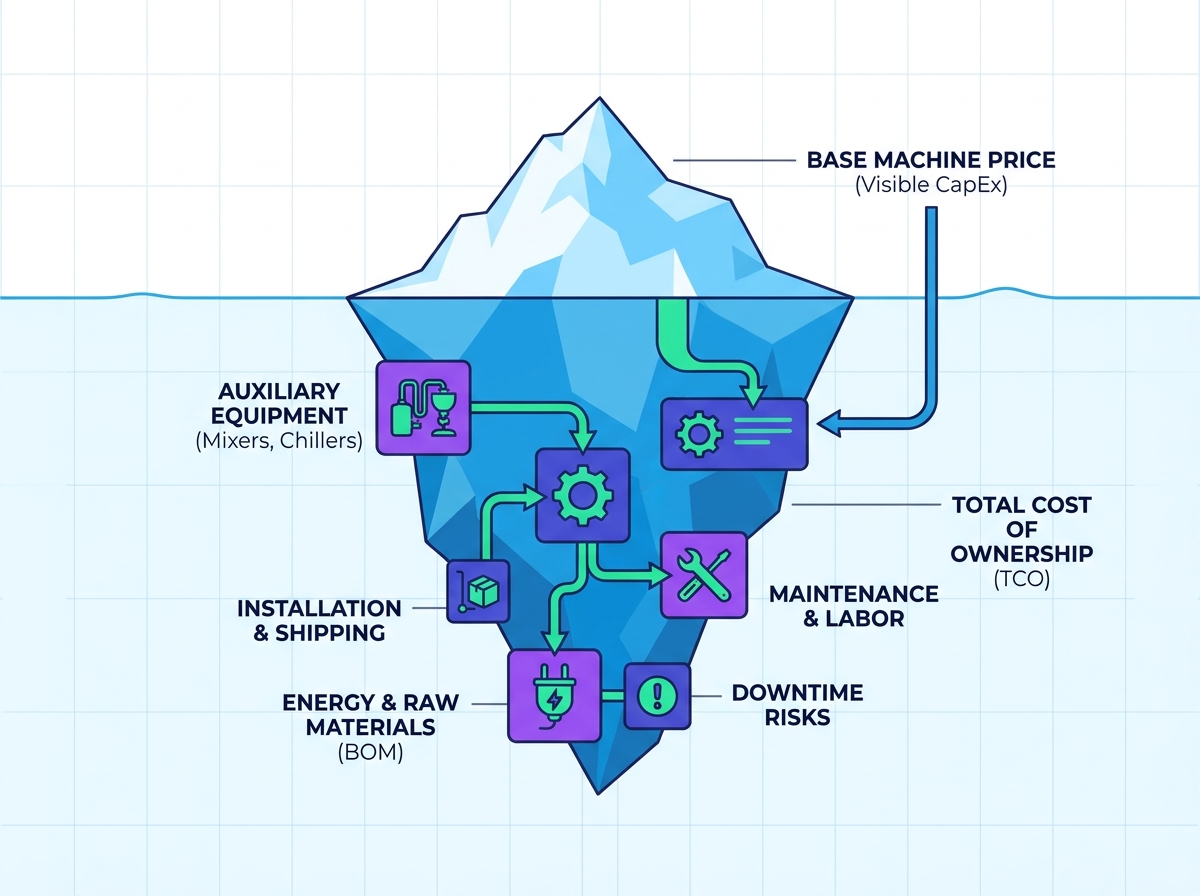
Standard FOB (Free on Board) quotes contain significant blind spots. An FOB quote merely places the equipment at the supplier's local port. It ignores the reality of launching a functional factory. Building trust with your investors requires highlighting these hidden expenses early.
The primary extruder cannot function in isolation. Buyers frequently overlook the mandatory support equipment. You must budget for the following auxiliary items:
High-speed heating and cooling mixers: You must blend PVC resin, calcium carbonate, and chemical additives. The mixer uses friction to heat the compound, then rapidly cools it to prevent premature degradation.
Plastic crushers and pulverizers: Start-up calibration generates scrap. You need crushers to grind rejected panels back into powder. Recycling this scrap protects your profit margins.
Industrial water chillers: The vacuum calibration table requires a constant supply of chilled water. Relying on ambient temperature water slows down your production speed drastically.
Air compressors: Pneumatic cutters and stackers require clean, dry compressed air to function accurately.
Transporting heavy industrial machinery involves complex logistics. Ocean freight rates fluctuate wildly. You must decide between CIF (Cost, Insurance, and Freight) and FOB terms. Furthermore, import tariffs add 10% to 25% to your base cost depending on your jurisdiction. Port handling fees, customs clearance, and heavy-duty inland trucking to your facility easily consume thousands of additional dollars.
Industrial extrusion lines do not assemble themselves. You must fly manufacturer technicians to your factory. You pay for their flights, visas, hotels, and daily wages. They wire the electrical panels, level the extruder, and calibrate the die. They also train your local operators. During this initial testing phase, you will waste raw materials. The first few days of operation produce unsellable scrap as the technicians dial in the temperature zones. You must include this wasted raw material in your initial startup budget.
Once the machine powers on, your focus must shift from initial purchasing to running the business profitably. Operational expenses dictate your survival in competitive markets.
Your Bill of Materials (BOM) dominates your daily budget. PVC resin provides the necessary structural flexibility. Stabilizers prevent the plastic from burning inside the heated barrel. Lubricants ensure the melt flows smoothly through the die. Calcium carbonate acts as the primary cost-saving filler. A well-engineered PVC wall panel machine handles higher filler ratios without degrading the screw prematurely. Pushing the calcium carbonate ratio higher drastically lowers your cost per square meter. However, you must balance this to ensure the panel remains impact-resistant. Lamination films also add to the BOM, varying in price based on design complexity.
Extruders consume massive amounts of electricity. You must distinguish between installed power and actual running consumption. A supplier quote might show 150 kW of installed power. This represents the absolute maximum draw when all heaters and motors spike simultaneously. Actual running consumption typically sits between 60% and 75% of the installed power. Utilizing premium PID temperature controllers and VFDs optimizes this consumption. Lowering your daily power draw directly increases your profit per panel.
Ongoing maintenance is non-negotiable. You must pay skilled operators to monitor the line. You must purchase specialized high-temperature grease for the gearboxes. Heater bands burn out and require regular replacement. Most importantly, the highly abrasive calcium carbonate filler will eventually wear out the screw and barrel. Depending on your production volume, you must budget for screw refurbishment or complete replacement every 12 to 18 months.
Choosing the right manufacturing partner mitigates financial risk. A methodical shortlisting logic protects you from deceptive pricing practices.
You must compare apples to apples when reviewing quotes from different suppliers. Follow this logical framework to normalize quotes:
Verify the extrusion capacity (kg/hour) rather than just the motor size.
Check the brand of all electrical components (drives, PLCs, contactors).
Identify which auxiliary machines are included in the final price.
Confirm the material grade of the calibration table (e.g., 304 vs. 201 stainless steel).
Supplier A might quote $40,000, while Supplier B quotes $65,000. If Supplier A omitted the chiller, the mixer, and uses generic motors, their quote is incomplete. Once you add the necessary components, Supplier B often provides the better comprehensive package.
Commercial compliance is mandatory. European and North American importers require strict CE and ISO certifications. Local safety inspectors demand them for factory insurance purposes. An uncertified machine lacking proper safety guards and emergency stops becomes a massive legal liability. Always request verifiable certification documents before placing a deposit.
Suppliers sometimes offer unrealistic warranties to close a deal. A ten-year warranty means nothing if the supplier has no local service infrastructure. Emphasize the reality of post-sale support. Ask about spare parts availability. Can they ship a replacement VFD via express courier within 48 hours? Do they offer remote PLC troubleshooting? Modern premium machines connect directly to the internet. A technician overseas can log into your PLC to diagnose software faults instantly. This remote capability saves weeks of frustrating downtime.
Investing in panel manufacturing requires looking far beyond the baseline sticker price. You must evaluate the complete financial footprint of the project. By accounting for robust extrusion mechanics, auxiliary support equipment, and long-term material efficiencies, you protect your operational margins. Successful manufacturers prioritize high-quality electrical components and heavily reinforced screw designs to minimize daily downtime and energy waste.
Before making any down payment, take clear, actionable steps. Demand a comprehensive bill of materials (BOM) from your supplier. Request a full equipment layout drawing to verify factory space requirements. Finally, secure a detailed energy consumption estimate. These steps ensure you launch your production line with absolute financial clarity.
A: The average payback period ranges from 8 to 18 months. This timeline depends heavily on your local market retail prices, regional utility costs, and factory utilization rates. Running multiple shifts accelerates the payback process significantly.
A: Yes, you can run different widths. While the primary extruder remains the same, you must factor in the cost of purchasing additional extrusion molds, dies, and calibration tooling specifically designed for each new width.
A: The price gap stems from internal component quality. The origin of the steel alloys, the durability of the gearbox, and the specific brand of the electrical components directly dictate the machine's lifespan and daily reliability.
A: While pre-mixed compounds exist, running an in-house high-speed heating and cooling mixer is standard industry practice. Mixing in-house allows you to control your own material costs, adjust filler ratios, and maintain strict formulation quality.


